Electrodeposition or Electroplating

Electrodeposition or Electroplating

Electroplating or galvanizing is a surface treatment that consists of depositing a metal onto a substrate (metallic or not) through chemical or electrolytic reduction for protection, improved conductivity, and better suitability for welding on the treated surface. Other applications include improving appearance, binding non-conductive particles to the electrodeposited layer, abrasion resistance, improving surface hardness, temperature resistance, among others.

Electrodeposition or electroplating:

According to the Rosseti Dictionary of Chemistry, we can define electroplating as the technology responsible for transferring metal ions from a given solid surface or liquid medium called an electrolyte to another surface, whether metallic or not. This process uses electric current and is called “electrolysis”.

Electroplating was developed by Galvani, a physicist and chemist who studied electricity.

Electrodeposition is related to surface coating; it is the process used in silver plating, nickel plating, chrome plating, etc.

The object to be coated during electrodeposition must be connected to the negative pole of the generator, forming the cathode. For example, we can apply a gold or silver bath (gilding and silver plating) to a ring made of aluminum. The ring will be the cathode, connected to the negative pole of the generator; connected to the positive pole there should be a gold sheet.

These electrodes must be immersed in an aqueous solution of a gold salt, for example, gold(III) nitrate (Au(NO3)3].

{ Au3+ + 3e- → Au } negative pole (half-reaction at cathode – reduction) { Au → Au3+ + 3e- } positive pole (half-reaction at anode – oxidation)

We could also use an inert electrode (platinum) at the anode, the aluminum ring at the cathode, and an aqueous solution of Au(NO3)3. The deposition of gold on the ring does not originate at the anode; the gold is present in the solution, and it is advisable that it be concentrated:

{ H2O → 2 H+ + ½ O2 + 2e- } positive pole (half-reaction at anode – oxidation) { Au3+ + 3e- → Au } negative pole (half-reaction at cathode – reduction)

If we want to chrome-plate an iron bumper, it must be connected to the negative pole of the generator, forming the cathode. The positive electrode must be a chromium bar, or else the electrode must be inert and the electrolytic solution must contain a chromium salt (Cr3+). Industrially, the process of chrome plating automobile bumpers is carried out in three stages: • Copper plating • Nickel plating and • Chrome plating. This is intended to provide greater adhesion to the chromium, preventing the bumper from peeling and losing the chrome plating.

In the electroplating process, the reactions are not spontaneous; it is necessary to supply electrical energy for electron deposition (electrolysis) to occur. Electroplating is therefore an electrodeposition process in which the object that will receive the metallic coating is connected to the negative pole of a direct current source and becomes the cathode. The metal that will provide the coating is connected to the positive pole and will be the anode. The object to be coated must conduct electric current. If the object is plastic, which is not a good conductor, a surface treatment will make it conductive. There is also the problem of adhesion of one metal to another. For the metal film to bond to the base, in addition to perfect cleaning and degreasing, it is necessary to know the nature of the metals.

Galvanizing Galvanizing or electroforming is the entire electrolytic process that consists of coating the surfaces of metal parts with other, more noble metals. This coating is generally applied to protect the part from corrosion and/or as an aesthetic/decorative finish.

Galvanizing consists of using two electrodes immersed in an electrolytic solution connected to a direct current source or alternating current, converted to direct current and rectified. The part to be coated must function as the cathode, i.e., it must be connected to the negative pole of the electric current source. The anode, connected to the positive pole of the source, may be made of an inert material (graphite, lead, stainless steel, platinized titanium, etc.) or made of the metal with which the part is to be coated. The electrolytic solution must contain, as the electrolyte, a salt that contains cations of the same metal.

When the anode is made of the metal with which the part is to be coated, the electrolytic process occurs with a transfer of metal from this electrode to the part through the electrolytic solution.
Example: Coating a part with silver, using a silver anode (silver plating):

Anode: Ag → Ag+ + e –
Cathode: Ag+ + e – → Ag
The anode metal oxidizes. The cation formed goes into the solution, and the cation in the solution is reduced at the cathode, adhering in metallic form.

When the anode is an inert material, the discharge of water from the solution occurs there. The cation in the solution is reduced at the anode, also adhering to the part.
Example: Coating a part with chromium, using an inert anode, lead (chrome plating):

Anode: H2 → 2 H+ + 1/2 O2 + 3 e-
Cathode: Cr3+ + 3 e- → Cr
When using an inert anode, the concentration of cations must be higher because there is no replenishment of them by the anode.

Depending on the metal with which the part or object is coated, galvanizing receives special names: gilding (gold), chrome plating (chromium), silver plating (silver), nickel plating (nickel), and others.

The galvanizing process, or the application of a zinc coating, can be carried out in the following ways:

Zinc plating or Electrolytic Galvanizing; (cold)
Hot-Dip Zinc Plating; (or by fire)
Thermal Spraying Zinc Plating – metallization

We divide electroplating technology into two main parts:

The first and most widely used is deposition by means of electrolysis. That is, through electric current, a difference in electrical potential is created, thus favoring the deposition of a metal onto another surface, usually metallic and with opposite polarity.
The second form, more elaborate and therefore less widespread, is chemical deposition, which consists of depositing dissolved metal ions in the form of their salts, which, due to a difference in chemical potential, tend to deposit onto other surfaces, metallic or not, generating deposits with characteristics often superior to electrolytic deposits in terms of cohesion and deposit density.

ELECTROLYTIC ZINC PLATING/GALVANIZING

White zinc plating;
Yellow zinc plating;
Black zinc plating;
Black oxidation.
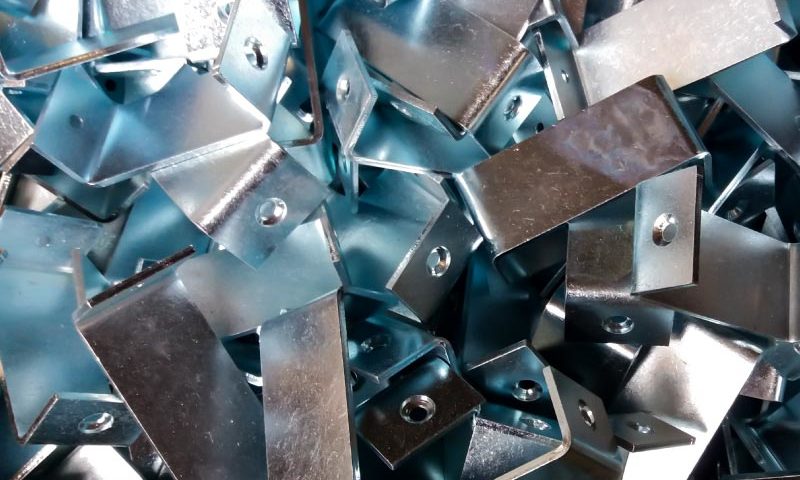
Zinc-Plated and Galvanized

What is the difference between zinc-plated and galvanized?

In fact, any process in which a metal part receives a coating of another, more noble metal, with the purpose of protecting against corrosion, providing greater conductivity, or simply for aesthetic reasons, is called Galvanizing!

DIFFERENCE BETWEEN ZINC-PLATED AND GALVANIZED

That’s right—zinc plating is also a form of galvanizing. The thing is that, popularly, when we call a part Galvanized, we are referring to Hot-Dip Galvanizing (or Hot-Dip Zinc Plating). And that is where the confusion arises.

ELECTRODEPOSITION OF METALS

Cold galvanization, in turn, can involve the use of zinc, copper, nickel, brass, gold, bronze, chrome, and so on. It is also known as electrolytic galvanization, as the chosen metal is deposited onto the part through a process involving electricity. This process is called metal electrodeposition.

Electrical energy must be supplied for the metal to be deposited from its ions through the supply of electrons (electrolysis). This is an electrodeposition process in which a direct current is forced through the electrodes and the solution, causing the coating metal to be connected to the positive pole to promote its oxidation, replenishing the solution with cations of the metal electrodeposited onto the conductive object connected to the negative pole.

Whereas, in Hot-Dip Galvanizing, it is done when carbon steel or cast iron parts are immersed in a tank of molten zinc (very hot!). The diffusion of zinc into the part’s crystal lattice provides much longer-lasting protection than in Electrolytic Galvanizing.

DIFFERENCE BETWEEN ZINC-PLATED AND GALVANIZED

Therefore, when someone asks you “What is the difference between zinc-plated and galvanized?” you can answer that zinc plating is a form of galvanizing, and there is no way to differentiate them—rather, they should be classified in the correct hierarchy along with other types of galvanizing.

Source: Indufix

Galvanizadora Bento Sul

Learn more about galvanization and its processes

Galvanization is the process of coating one metal with another to protect it against corrosion or to improve its appearance. It is a surface coating process using electrolysis, where the metal to be coated acts as the cathode and the coating metal acts as the anode (an inert material can also be used as the anode). The electrolytic solution must contain a salt composed of cations of the metal intended for the coating. The thickness of the layer deposited by the electrogalvanization process is controlled through mathematical models.

The coating of metallic surfaces can also occur by immersing the metal to be coated into the molten metal that will cover it. However, the electrolytic process allows for better (more homogeneous) coverage, although both methods are equally utilized. In this immersion process, the coating thickness is controlled by the speed at which the part passes through the metallic bath, the furnace temperature of the coating metal, and the application of a nitrogen jet at the end of the process.

Different metals can be used for coating a part. The process of coating with chromium, for example, is called “chrome plating”; if the coating is nickel, it is called “nickel plating.” We also have zinc, tin, magnesium, gold, copper, silver, etc. Each coating metal can provide different characteristics to the galvanized material according to its properties, such as higher or lower conductivity, or resistance to extreme temperatures.

The coating of thin steel sheets with tin results in a product called “tinplate,” used in the manufacture of cans to store various products such as preserves, oils, etc. Tin is used for this application because it is a metal that exhibits greater resistance to oxidation when in contact with water, which is generally present in these products. The process of coating steel with tin is generally performed by immersion.

In the case of iron, the most common corrosion protection is achieved through the deposition of metallic zinc. Zinc has the characteristic of oxidizing faster than iron. Thus, if a crack or peeling occurs in a galvanized iron* plate, leaving the iron exposed, the zinc will oxidize faster than the iron. Therefore, as long as there is zinc, the iron will not be oxidized.

*Zinc-coated iron is generally referred to as “galvanized iron.”

Sources:
http://www.cdcc.usp.br/exper/medio/quimica/6eletroquimg.pdf
http://educar.sc.usp.br/ciencias/quimica/qm1-3.htm#termica
http://www.cienciamao.usp.br/dados/t2k/_quimica_q23d.arquivo.pdf

Galvanizadora Bento Sul O que é Galvanização eletrolítica

O que é Galvanização eletrolítica?

O que é Galvanização eletrolítica. Aplicação de recobrimento de zinco por eletrodeposição. É uma técnica que permite um recobrimento mais uniforme do que a imersão a quente, e não influi nas propriedades mecânicas do material.

Galvanização é o processo de aplicação de uma camada protetora de Zinco ou ligas de Zinco a uma superfície de aço ou ferro de modo a evitar a corrosão destes.

zincagem eletrolítica é o processo de deposição de uma camada de zinco sobre a superfície de uma peça. O processo ocorre por meio de um banho metálico dado às peças, de forma que tenham tanto a sua resistência quanto a sua aparência aperfeiçoadas.

O zinco é um dos mais eficientes elementos para o revestimento de peças metálicas, pois ele atua como um isolante da peça banhada, evitando que o item tenha contato com o ar e se oxide com facilidade.

O tratamento dado às superfícies feito por meio da zincagem eletrolítica conta, ainda, com um conjunto de substâncias químicas conhecido como passivadores. Estes passivadores têm como função selar a camada de zinco depositada nas peças, aumentando o seu poder de resistência à oxidação.

Os passivadores também garantem uma coloração diferente às peças e, caso seja o desejo do cliente, há as opções azul, amarelo ou preto para a galvanização. As peças que são submetidas à zincagem eletrolítica têm seu acabamento superficial bastante uniforme, liso e com brilho, com a possibilidade de coloração.–

zincagem eletrolítica é amplamente utilizada por indústrias de diversos setores do mercado e mesmo consumidores finais, para tratamentos superficiais de portões, estruturas metálicas, peças automobilísticas estruturais e de acabamento, máquinas, equipamentos e os mais variados componentes.

Você sabe como funciona o processo de Galvanização? Para que serve?

O ferro e o aço são materiais muito utilizados na produção de peças metálicas. O aço é uma liga metálica composta em sua maioria de ferro, possui também carbono e traços de silício, enxofre e de oxigênio.No entanto, um aspecto negativo dos materiais feitos de ferro e de aço é que, com o tempo, eles se enferrujam e geram enormes prejuízos econômicos e ambientais. Estima-se que aproximadamente 20% do ferro produzido mundialmente tem a única finalidade de substituir peças enferrujadas.Para impedir ou pelo menos diminuir esses prejuízos, existem vários métodos de proteção contra a corrosão dos metais, sendo que um dos mais eficientes é a galvanização.A galvanização é um processo em que se reveste uma peça de ferro ou de aço com zinco metálico.A ferrugem se forma pela oxidação do ferro metálico a cátion ferro em presença do oxigênio do ar e da água. O ferro e a maioria dos metais (com exceção do ouro e da platina) possuem menor potencial de redução que o oxigênio e, por isso, esses metais tendem a se oxidar.

Galvanizadora Bento Sul

Você sabe qual a utilidade de um lavador de gases?

O que é um lavador de gases?

O lavador de gases é um equipamento que atua para coletar todas as partículas de gases e de vapores nos ambientes. Ele conta com um mecanismo de água pulverizada e bicos pressurizados. Quando em operação, o equipamento ajuda a controlar a poluição do ar, removendo materiais particulados do ambiente. O processo de funcionamento do lavador de gases ocorre por meio da colisão de partículas com um sistema de lavagem com água ou outro tipo de fluido.

O dispositivo do lavador de gases normalmente emprega a água pulverizada e conta com uma câmara. No ato da coleta das partículas, acontece uma colisão das gotas e dos resíduos. Após essa coleta, basta empregar processos mecânicos para eliminar as gotas e as partículas de impurezas.

Benefícios do lavador de gases

São diversos os benefícios diretos dos lavadores de gases. Com a correta interação entre gotas e partículas de impurezas, o ambiente fica mais limpo e seguro para a saúde. Além disso, o lavador de gases também reduz o fluxo de gases e poluentes provenientes de processos industriais.

O equipamento opera a partir de uma fonte de energia e trabalha para nebulizar o meio de lavagem. O lavador pode ter um orifício de passagem anular, vazão pré-ajustada, grau de turbulência e nível de atomização apropriados para cada tipo de ambiente, entre outras características.

Em geral, os lavadores são empregados em processos industriais que precisam processar os gases resultantes de atividades químicas e físico-químicas. Os aparelhos modernos podem ser usados em várias faixas granulométricas. Cada indústria pode solicitar um perfil de lavador ideal para a sua atividade, de acordo com as necessidades e demandas de cada segmento.

Entre as vantagens do lavador de gás, é possível citar:

  • Tratamento de poluentes sólidos, gasosos e líquidos;
  • Operação eficiente em variadas condições;
  • Sem restrição de temperatura para gases;
  • Sem restrição de umidade para os gases;
  • Controle de substâncias combustíveis;
  • Perfil compacto;
  • Permite o desenvolvimento de projetos personalizados.

Para mais informações sobre os lavadores de gases, entre em contato com os profissionais da Ventitec Li-AR! A empresa é especializada neste tipo de sistema e conta com um amplo portfólio de projetos realizados de forma bem-sucedida!