


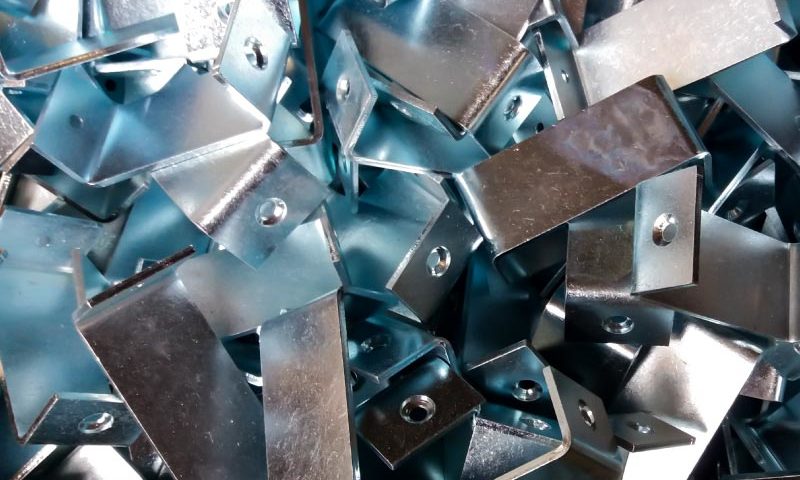
In fact, any process in which a metal part receives a coating of another, more noble metal, with the purpose of protecting against corrosion, providing greater conductivity, or simply for aesthetic reasons, is called Galvanizing!
DIFFERENCE BETWEEN ZINC-PLATED AND GALVANIZED
That’s right—zinc plating is also a form of galvanizing. The thing is that, popularly, when we call a part Galvanized, we are referring to Hot-Dip Galvanizing (or Hot-Dip Zinc Plating). And that is where the confusion arises.
ELECTRODEPOSITION OF METALS
Cold galvanization, in turn, can involve the use of zinc, copper, nickel, brass, gold, bronze, chrome, and so on. It is also known as electrolytic galvanization, as the chosen metal is deposited onto the part through a process involving electricity. This process is called metal electrodeposition.
Electrical energy must be supplied for the metal to be deposited from its ions through the supply of electrons (electrolysis). This is an electrodeposition process in which a direct current is forced through the electrodes and the solution, causing the coating metal to be connected to the positive pole to promote its oxidation, replenishing the solution with cations of the metal electrodeposited onto the conductive object connected to the negative pole.
Whereas, in Hot-Dip Galvanizing, it is done when carbon steel or cast iron parts are immersed in a tank of molten zinc (very hot!). The diffusion of zinc into the part’s crystal lattice provides much longer-lasting protection than in Electrolytic Galvanizing.
DIFFERENCE BETWEEN ZINC-PLATED AND GALVANIZED
Therefore, when someone asks you “What is the difference between zinc-plated and galvanized?” you can answer that zinc plating is a form of galvanizing, and there is no way to differentiate them—rather, they should be classified in the correct hierarchy along with other types of galvanizing.
Source: Indufix



 WhatsApp